
How Much Do Facebook Ads Cost in Canada in 2026?

If you've ever typed "how much do Facebook ads cost" into Google, you've probably found a dozen answers that don't agree, most of them written for online stores rather than for a painter or a window cleaner in Ontario.
So instead of repeating someone else's average, we pulled the numbers from 31 Canadian home service ad accounts our team ran from February 9 to July 6, 2026. You'll see the medians, the ranges and the months where costs climbed, plus how to turn a cost per lead into the number that actually pays your bills, which is what each new customer costs you.
How much do Facebook ads cost in Canada at a glance?
In our Canadian home service accounts, the typical account paid $20.99 CAD per lead, and across all of the accounts the ads cost $18.31 CAD per 1,000 impressions and $2.03 CAD per link click, from February 9 to July 6, 2026. Here is every headline number in one place.
| Metric | What our accounts paid (CAD) |
|---|---|
| Cost per lead, typical account (median of 28 accounts) | $20.99 |
| Cost per lead, middle half of accounts | $15.23 to $32.39 |
| Cost per lead, cheapest to most expensive account | $10.56 to $46.09 |
| Cost per lead overall (all spend divided by all leads) | $22.83 |
| Cost per lead, median ad (231 ads) | $27.55 |
| CPM (cost per 1,000 impressions) | $18.31 |
| Cost per link click | $2.03 |
| Link click-through rate | 0.90% |
Source: Meta Ads Manager exports from 31 Canadian home service ad accounts our team ran, February 9 to July 6, 2026. Lead campaigns only, in Canadian dollars, before tax.
What is the Facebook ads cost per lead in our Canadian accounts?
Across all 31 accounts, our team spent $108,950 CAD on Facebook and Instagram lead campaigns and produced 4,773 leads, which works out to $22.83 per lead overall. That figure leans toward the biggest spenders, so the more useful number for a single business is the median account, which paid $20.99 per lead.
Overall: where most accounts landed
Half of the accounts landed between $15.23 and $32.39 per lead, and the full spread ran from $10.56 for the cheapest account to $46.09 for the most expensive. These businesses sold similar services in the same country over the same months, so that gap shows how much the things you control (offer, creative, area and follow-up) move the price.
Individual ads ran a little higher, partly because many ads only get a small share of the budget before Meta moves spend to a stronger one. The median ad cost $27.55 per lead, with the middle half of ads between $16.25 and $41.97.
By month: what the season did to cost per lead
The season moved cost per lead more than anything else in our data. Leads were cheapest in March, at $14.96, and April, at $17.12, when demand for exterior cleaning was building and few competitors were advertising yet. By June the cost had climbed to $30.93 as budgets rose and the season got crowded, and the first six days of July sat at $30.76. CPM followed the same path, from $14.01 in March to $21.40 in June.
| Month (2026) | Spend (CAD) | Leads | Cost per lead (CAD) |
|---|---|---|---|
| March | $11,609 | 776 | $14.96 |
| April | $20,694 | 1,209 | $17.12 |
| May | $24,629 | 1,112 | $22.15 |
| June | $41,969 | 1,357 | $30.93 |
| July (to July 6 only) | $9,104 | 296 | $30.76 |
One honest caveat: most of the sample is seasonal exterior and window cleaning, so spring and early summer dominate it. Read these months as what we saw in seasonal exterior services rather than a rule for every trade, since a business with steady demand all year may see a flatter line.
By business type
Exterior and window cleaning is the only business type in our sample with enough accounts to treat as a benchmark. The others are real results, but each is a single account, which makes it a story rather than a benchmark.
| Business type (sample) | Accounts | Cost per lead (CAD) |
|---|---|---|
| Exterior and window cleaning (strong sample) | 28 | $22.80 |
| Decks and landscaping (one account, 20 weeks) | 1 | $21.02 |
| Home maintenance (one account, 8 weeks) | 1 | $19.54 |
| Residential painting (one account, 9 weeks, higher ticket) | 1 | $38.22 |
Blended cost per lead for each business type (all spend divided by all leads), February 9 to July 6, 2026.
The painting account, the highest-ticket service in the group, paid the most per lead, but one account can't tell you whether painting always costs more. If your trade isn't listed, we don't have numbers for it yet, and we'd rather say so than guess.
Why do published averages for Facebook ads cost per click in Canada disagree?
Published averages disagree because they measure different things, for different businesses, in different years. Public figures for Canadian cost per click range from about $0.92 to $2.97 depending on the source, and many of them are global ecommerce averages or projections rather than measured Canadian results, often without a clear currency or date attached.
An online store selling t-shirts to the whole country and a deck builder reaching homeowners near their shop play very different games, even in the same auction. Meta's ad auction weighs your bid, how likely people are to respond and the quality of your ad, so what you pay depends on who you're reaching and how good your ad is. If you're also weighing search ads, our Facebook ads vs Google ads comparison explains why their click prices can't be compared one to one.
What do CPM, cost per click and cost per lead mean?
- CPM (cost per 1,000 impressions) is what you pay for your ad to be shown 1,000 times. Ours was $18.31.
- CPC (cost per click) is what you pay, on average, for each click. Our cost per link click was $2.03, from a link click-through rate of 0.90%.
- CPL (cost per lead) is what you pay for each person who fills out your form or contacts you. Ours was $22.83 overall and $20.99 for the typical account.
- Cost per customer is what you pay in ads for each person who hires you. Meta can't show you this one, because it depends on what happens after the lead comes in.
Why should a local service owner care about cost per lead and cost per customer?
If you run a service business, a click doesn't pay your bills. A Facebook lead form can produce a lead without anyone visiting your website, so the price of a click tells you very little about whether the campaign is working. What matters is how much you pay for each lead, and how many of those leads become paying customers.
That's why our team judges every campaign on cost per lead first and cost per customer second. A lead that costs twice as much but books a big job beats a cheap lead who never picks up the phone, and only cost per customer shows you that.
What makes the cost of Facebook ads for a small business go up or down?
Six things decide most of what you pay: the season, your area, your offer, your creative, lead form or landing page, and your follow-up. Some change what Meta charges, and some change how many leads become customers.
Season
Cost per lead roughly doubled from March to June in our accounts, and the cheapest leads came early, before most competitors had turned their ads on. If your work is seasonal, start a few weeks before your busy months instead of waiting until the phone should already be ringing. Our guide to Facebook ads for window cleaners applies this to one of the most seasonal trades we work with.
Area size
A small town or a tight radius gives Meta fewer people to show your ad to. Once the same few thousand homeowners have seen your ad several times, each extra lead gets harder to find and more expensive. A larger area gives the system more room, so draw it around everywhere you'd happily drive for a job.
Offer
A clear, valuable offer gets more people to raise their hand for the same spend. A free quote is an offer, but so is a seasonal package or a smaller service added free to a bigger job, which gives people a reason to book now. When the offer is weak, Meta has to show your ad to more people to find each lead, and you pay for every one of those impressions.
Creative
Creative is the ad itself, the video or picture and the words on it, and it's the biggest lever you control. In our accounts, video ads came in cheaper per lead than ads built on a single still picture, though we ran far fewer of those: the median video ad cost $25.92 per lead across 160 ads, against $31.11 across just 14 still-picture ads, which is too few to call proof. In several of our window cleaning accounts, a real person talking to the camera has also beaten polished production. Our lessons from $20,000 in ad spend explain why giving Meta several ads to choose from works better than hunting for one perfect ad.
Lead form or landing page
A Facebook lead form keeps people inside the app, so it usually brings in more leads for the money. A landing page asks people to leave Facebook first, which tends to cost more per lead but filters out some people who aren't serious. Lead forms need fast follow-up and a few screening questions, and landing pages need to load quickly, show real reviews and track every form. For clients, our team builds a funnel for the business: a lead form, landing page or review page, whichever fits.
Follow-up
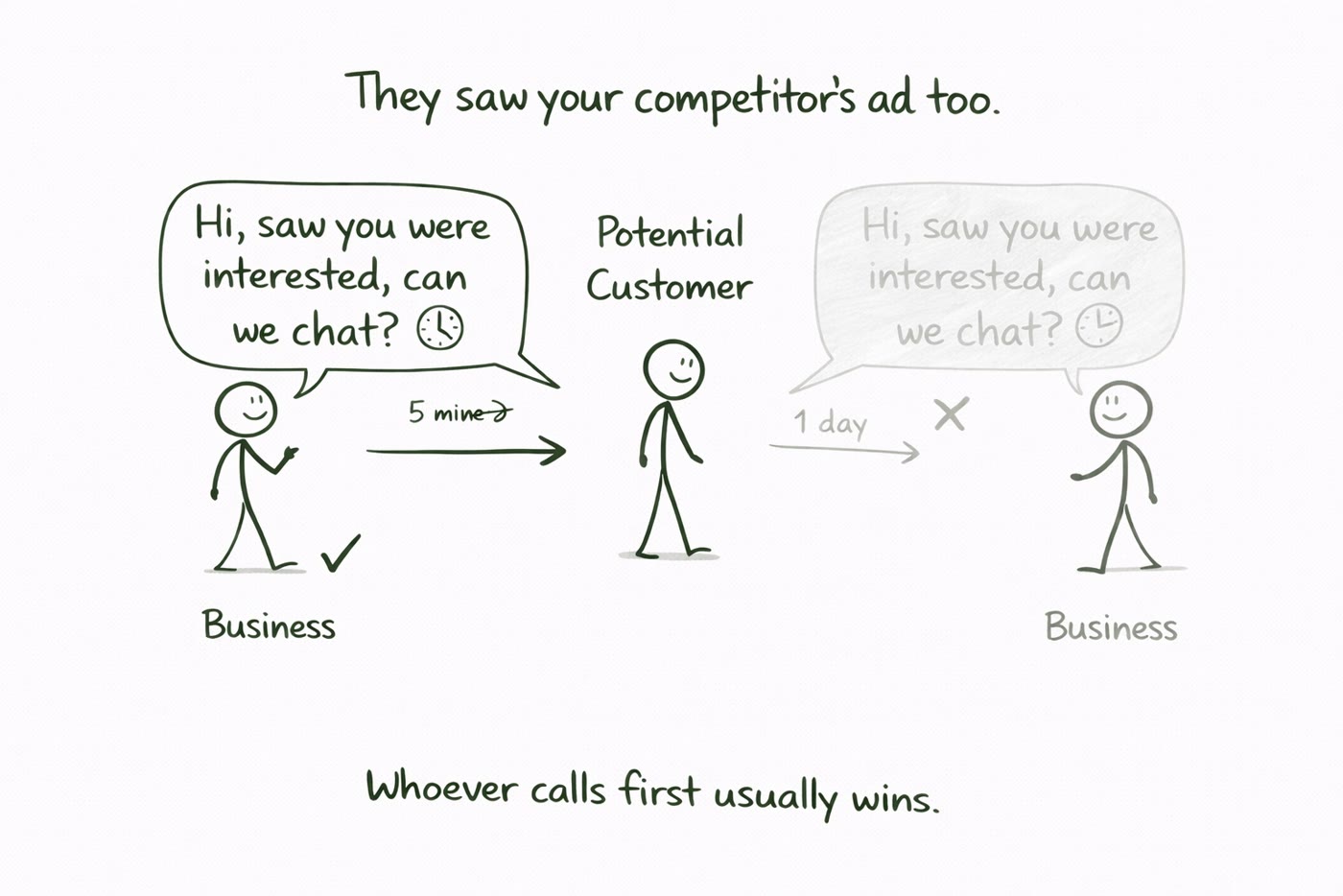
Follow-up doesn't change what Meta charges you, but it decides what each lead is worth. A lead you call within minutes is far more likely to book than one you call tomorrow, because they're probably seeing your competitors' ads too. When owners tell us their leads are bad, slow follow-up is one of the first things we check, and our lessons from generating $1M for local businesses show how much the work after the lead shapes the result.
What should you budget to start?
Start with a monthly amount you could keep running for at least a couple of months without stress, because the first few weeks are partly spent teaching Meta who your customers are. How low you can safely go is its own question, and we answer it with the math in Is $10 a day enough for Facebook ads?
To set a starting number, take a realistic cost per lead, such as the $20.99 our typical account paid, and multiply it by the number of leads a month you can actually call and quote. In our accounts, weeks under $20 a day brought the typical account a median of 0.86 leads a day, so build your budget around the leads you can genuinely follow up on.
Then give it time, because new ads go through Meta's learning phase, and big edits can restart it, so judge your first campaign over weeks rather than days. Our low budget guide for local service businesses walks through the setup we use when every dollar has to count.
How do you work out your cost per customer?
Your cost per customer is your monthly ad budget divided by the number of customers those ads brought you. To estimate it before you spend a dollar, you only need three numbers: your monthly budget, your expected cost per lead and your close rate, which is the share of leads who end up hiring you.
- Leads per month = monthly budget ÷ cost per lead
- Customers per month = leads per month × close rate
- Cost per customer = monthly budget ÷ customers per month
In this worked example, the budget and close rate are picked to show the math, and the cost per lead is our typical account's figure.
| Step | Worked example (CAD) |
|---|---|
| Monthly ad budget (example) | $1,000 |
| Cost per lead (our typical account) | $20.99 |
| Leads per month: $1,000 ÷ $20.99 | About 47.6 leads |
| Close rate (example) | 20%, or 1 in 5 leads |
| Customers per month: 47.6 × 20% | About 9.5 customers |
| Cost per customer: $1,000 ÷ customers, or the shortcut $20.99 ÷ 20% | $104.95 |
The shortcut in the last row works every time: cost per lead divided by close rate gives you cost per customer. Make sense? Try your own numbers below.
Cost per customer calculator
To compare your cost per customer against what a job is worth to you, use the worksheet in Are Facebook ads worth it for your business? And if you'd like to learn to bring these numbers down yourself, the free Acquirely Academy has the full Meta ads course plus a community where you can ask questions and get real answers from our team and other owners.
Questions
Frequently asked questions
Do these Facebook ad costs apply to businesses in the US?
Not directly. Every figure on this page comes from Canadian home service accounts, and we don't yet have enough US home service data to publish separate US numbers. The cost drivers in this guide still apply in the US, but your prices could land higher or lower, so treat your own first month of results as your benchmark and compare against that.
Are Facebook ads charged in Canadian dollars?
Meta bills you in the currency set on your ad account, so check which one yours uses before you compare your numbers with anyone else's. Every figure on this page is in Canadian dollars, before tax. If your account runs in US dollars, convert first, and ask your accountant how sales tax applies to your ad charges, since it can add to what you actually pay each month.
Is advertising on Instagram cheaper than Facebook?
Facebook and Instagram ads are bought through the same Ads Manager and the same auction, and one campaign can run on both at once. The figures on this page combine the two, because that's how our lead campaigns ran. We haven't split our sample by placement, so we can't tell you that one is cheaper for local service businesses, and we'd be wary of a single answer with no data behind it.
Does boosting a post cost less than running an ad?
A boost often looks cheaper because it usually optimizes for likes, comments and views, and those are cheap to buy. For a service business that number doesn't mean much. If you want quote requests, a lead campaign built in Ads Manager lets Meta look for people who are likely to fill out a form, and every figure on this page comes from campaigns set up that way.
Do Facebook ads cost more in winter?
We can't answer that from this data yet. Our sample runs from February 9 to July 6, 2026, so it covers the build-up to the busy season and the peak, but not fall or winter. What it does show is that cost per lead moved a lot with the season, so expect your own costs to shift through the year, and compare each month against the same month last year once you have that history.
Do I pay for a Facebook ad if nobody clicks?
In most cases, yes. For most campaign types, including the lead campaigns in this guide, Meta charges you each time your ad is shown, which is why CPM matters. In our accounts it was $18.31 per 1,000 impressions. If an ad gets shown a lot but nobody responds, you still pay for those impressions, which is one way weak creative quietly raises your cost per lead.
Written by
Brayden Pauls
Co-founder of Acquirely
Brayden co-founded Acquirely with his cousin Ethan after the two of them had to find customers for their own window cleaning business in Ontario. He loves teaching owners how advertising really works, and he writes these guides from what our team sees in the accounts we manage. Acquirely helps small businesses generate leads and customers through paid advertising and practical marketing systems.
More about Brayden and Ethan