Are Facebook Ads Worth It for Your Business? Run Your Own Numbers With This Worksheet

Ask ten marketers whether Facebook ads are worth it and you'll get ten opinions, most of them from people who sell ads. The more useful answer comes from three numbers you already know about your own business, plus one number we can give you from the accounts our team runs.
This post gives you a worksheet you can fill in on paper or with the calculator below, shows what leads actually cost in the accounts we ran in 2026, and tells you plainly when the answer is no, because for some businesses it is.
Who is this worksheet for?
This worksheet is for owners of small, local businesses across Canada and the US who sell a service with a fairly clear price, like cleaners, painters, deck builders, landscapers, renovators, clinics and studios. If you can say roughly what an average job is worth and how many enquiries turn into paying customers, you can use it.
If you already run ads, use your real cost per lead from Ads Manager instead of ours, and the worksheet will tell you whether your campaign is making you money.
What three numbers decide whether Facebook ads are worth it?
Three numbers decide it: what a job is worth to you, how many leads become customers, and what each lead costs. The first two come from your own records and the third from Ads Manager, or from our numbers until you have your own.
Average job value and gross margin
Average job value is what a new customer typically pays you for their first job, before tax. If customers come back, use their first-year value instead, since a $300 window cleaning that repeats twice a year is really a $600 customer. Gross margin is the share of each job you keep after labour, materials and other direct costs, so a $4,000 paint job that costs you $2,400 to deliver has a 40% gross margin.
Close rate from lead to customer
Close rate is the percentage of leads that end up paying you. Our team works it out in two steps, because that's how most service businesses sell: the share of leads who book an estimate, multiplied by the share of estimates you win. If 40% of leads book and you win 25% of those, your close rate is 10%. Count every lead, including the ones who never picked up.
Cost per lead
Cost per lead is your ad spend divided by the number of leads it produced. Across the 31 home service accounts in our sample, the typical account paid about $21 CAD per lead from February 9 to July 6, 2026. For what drives that number, see our guide to what Facebook ads cost in Canada.
That result is your break-even cost per lead, the most you can pay for a lead before the ads cost more than the jobs earn. Our team uses the same math to set targets for new clients: revenue per lead equals job value times the lead-to-estimate rate times the estimate-to-close rate, and we want leads to cost a small slice of that, so there's room for profit and for slow weeks.
How do you work out your Facebook ads break-even?
Your break-even cost per lead is your average job value times your gross margin times your close rate, and the worksheet below gets you there in ten short lines. Fill in the five numbers at the top and work down with a phone calculator. It works just as well printed or copied onto paper.
The paper worksheet
| Line | How to work it out | Your number |
|---|---|---|
| A. Average job value ($ CAD) | Your invoices (first-year value if customers repeat) | |
| B. Gross margin (%) | What you keep after direct costs | |
| C. Close rate, lead to customer (%) | Share who book, times share you win | |
| D. Cost per lead ($ CAD) | Ads Manager, or about $21 from our accounts | |
| E. Monthly ad budget ($ CAD) | What you can comfortably invest | |
| F. Leads per month | E ÷ D | |
| G. Customers per month | F × C | |
| H. Cost per customer | D ÷ C | |
| I. Gross profit from ads | (G × A × B), minus E | |
| J. Break-even cost per lead | A × B × C |
Write percentages as decimals when you multiply (40% is 0.40). If line D is lower than line J, every lead costs less than it earns and the ads are worth it on paper. If D is higher than J, you need cheaper leads, a better close rate or a bigger job before ads make sense.
The calculator
Change any number below and the results update as you type. It starts with a hypothetical $4,000 paint job at about $21 CAD per lead, our typical account's cost from February to July 2026.
Calculator
Facebook ads break-even calculator
- Leads per month
- Customers per month
- Cost per customer
- Gross profit from ads
- Break-even cost per lead
Worth it on these numbers: leads at $21 cost less than your $160 break-even.
Hypothetical example on a $1,050 monthly budget (about $35 a day). Gross profit from ads is after ad spend and before fees, software and your own time.
Three worked examples at different ticket sizes
Here is the same math for three made-up businesses, each on about $35 a day ($1,050 a month) at about $21 CAD per lead, which gives 50 leads a month. These are not client results.
| Example (hypothetical) | $300 cleaning | $4,000 paint | $15,000 deck |
|---|---|---|---|
| Gross margin | 50% | 40% | 35% |
| Close rate, lead to customer | 30% | 10% | 4% |
| Customers per month | 15 | 5 | 2 |
| Cost per customer | $70 | $210 | $525 |
| Gross profit from ads, per month | $1,200 | $6,950 | $9,450 |
| Break-even cost per lead | $45 | $160 | $210 |
The cleaning business makes money, but a month where cost per lead drifts toward its $45 break-even would wipe most of it out, which is why repeat business matters so much at small ticket sizes. If you clean windows, our guide for window cleaners covers offers and lead costs for that trade.
The paint and deck businesses have far more room, because one extra customer pays for months of ads. Big-ticket leads usually take longer to close and often cost more, though, so treat the deck column as the most optimistic. Our one residential painting account paid about $38 CAD per lead, which would raise the paint example's cost per customer to $380, still well under break-even.
What do Facebook ads cost per lead in our accounts?
Across 31 Canadian home service accounts our team ran from February 9 to July 6, 2026, the typical account paid about $21 CAD per lead, and half of accounts landed between about $15 and $32 per lead. The cheapest and most expensive accounts ran from about $11 to $46 per lead, and the overall figure, all spend divided by all leads, was about $23 per lead.
That spread is why you should run your math at $21, then again at $32 and $46. If the ads still pay at the expensive end, your business can absorb a rough month.
Cost per lead by month
| Month (2026) | Spend (CAD) | Leads | Cost per lead |
|---|---|---|---|
| March | $11,609 | 776 | $14.96 |
| April | $20,694 | 1,209 | $17.12 |
| May | $24,629 | 1,112 | $22.15 |
| June | $41,969 | 1,357 | $30.93 |
| July (to July 6 only) | $9,104 | 296 | $30.76 |
Leads were cheapest in March and April, when exterior cleaning demand was building and few competitors were advertising, and they roughly doubled in cost by June as budgets rose and the season got crowded. Most of this sample is seasonal exterior and window cleaning, so read it as what we saw in seasonal exterior services rather than a rule for every trade.
Daily budget and leads per day
| Average daily spend that week (CAD) | Account-weeks | Median leads per day |
|---|---|---|
| Under $20 | 161 | 0.86 |
| $20 to $35 | 109 | 1.43 |
| $35 to $50 | 78 | 1.57 |
| $50 to $80 | 35 | 1.86 |
| $80 and up | 44 | 3.14 |
Under $20 a day, the typical account got a little under one lead a day (about 6 a week), and $20 to $50 a day roughly doubled that to 1.4 to 1.6. Leads keep rising with budget, but not in a straight line, because cost per lead tends to climb as you spend more in the same small area.
Our worked examples assume 50 leads a month on about $35 a day, which is about 1.6 a day and in line with the 1.57 median above. For whether a smaller budget can work, see Is $10 a day enough for Facebook ads?
When are Facebook ads not worth it?
Facebook ads are not worth it when your break-even cost per lead sits below what leads realistically cost, or when the business can't handle the leads. In these cases we'd tell you to wait.
- Your job is small and customers don't come back. A hypothetical $100 one-time service at a 50% margin and a 20% close rate breaks even at $10 per lead, below even the cheapest account in our sample at about $11.
- Nobody can answer the phone. If leads land while you're on a roof all day and nobody calls back until evening, you're paying for leads that go cold.
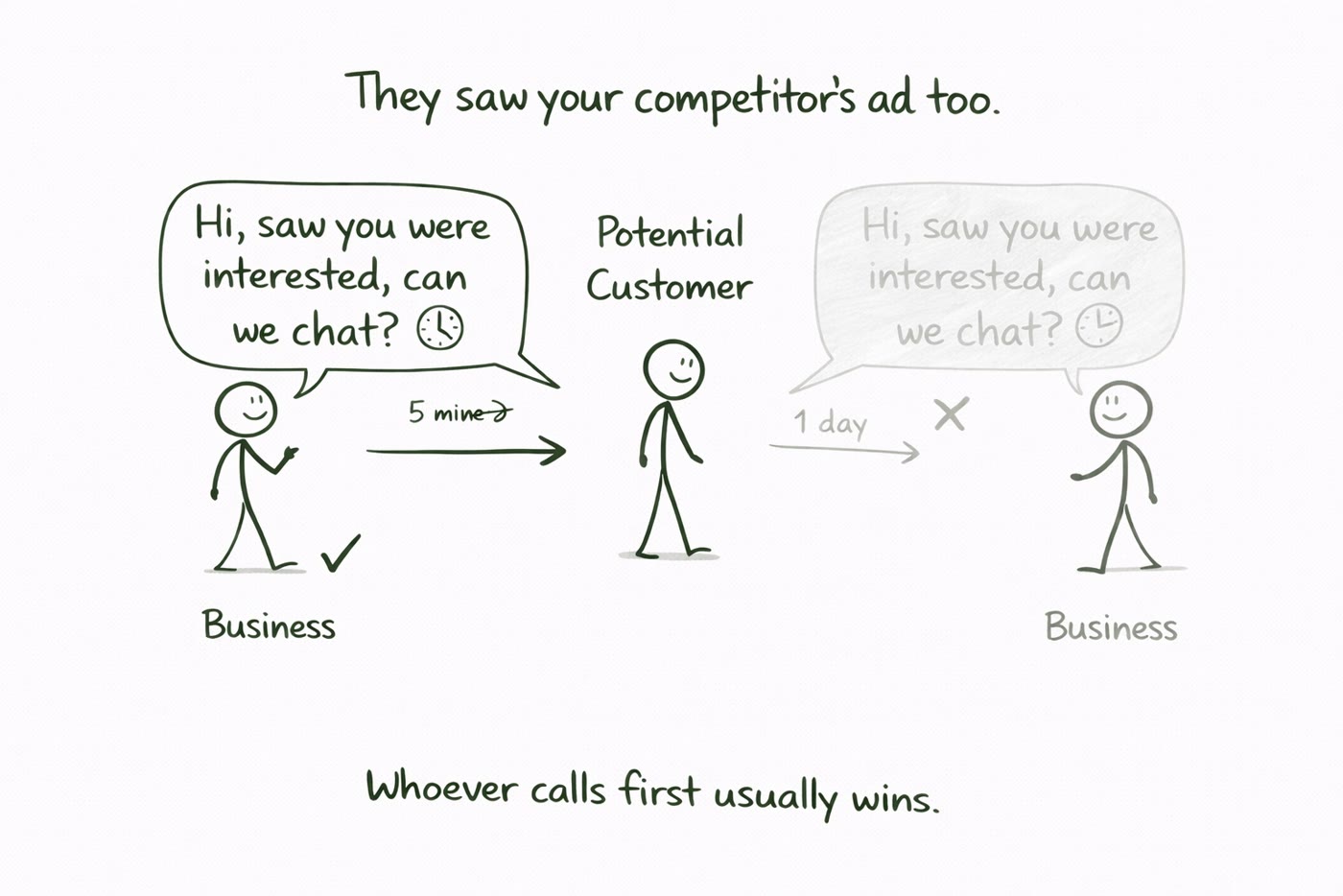
- You can't follow up fast. People who fill in a form are interested right now and are often seeing your competitors' ads too, so slow follow-up drags down your close rate.
- You can't commit 60 to 90 days. Meta's system needs time and data to learn who responds, which Meta calls the learning phase, and profitable campaigns come from testing creative over a few months.
- Your service area is very small. The pool of buyers in one small town runs out quickly, and cost per lead tends to climb as you spend more in the same small area.
- People search for you the moment they need you. Emergency work like a burst pipe is bought by someone searching that minute, which often suits Google better. Our Facebook ads vs Google ads comparison explains when to pick one or run both.
Ads need a few months to really work, so they should be funded with money you can comfortably invest. If that's not where you are right now, start with our free Academy. You'll learn how Meta ads work at your own pace, and we'll be here when the timing is right.
What changes the answer fastest?
Three things move the worksheet most: a stronger offer, faster follow-up and more creative for Meta to test. The first two raise your close rate, and the third usually lowers your cost per lead.
A better offer
An offer is what someone gets for saying yes, and it works mostly on your close rate. One structure we like is stacking a free smaller service onto a bigger paid one, like free window cleaning with a sealing job, where the freebie costs the business a small slice of the job but feels generous to the customer. Raise the close rate from 10% to 12% in the calculator and watch what it does to break-even.
Faster follow-up
Follow-up speed is the cheapest improvement most owners can make. Someone who just filled in your form wants an answer while they're still thinking about it, and the business that calls first has the best shot at the job. Our low budget guide for local service businesses walks through a simple follow-up setup.
More creative for Meta to test
Creative is the ad itself, and it decides much of what you pay per lead. Two patterns keep showing up across the home service accounts we run. Video with a real person talking to camera beats static ads for local services, because the buyer is hiring a person. Ads that open on the homeowner's visible problem, with movement and big on-screen words in the first seconds, beat ads that open with a calm, rational setup.
In our accounts, video ads came in cheaper per lead than image ads (medians of about $26 and $31 CAD per lead, February to July 2026), though we ran far fewer image ads, so treat that as a lean rather than proof. In one account we wrote about in What $20,000 in Facebook Ad Spend Taught Us, giving Meta more ads to choose from without raising the budget brought costs back down, which is part of why our team ships 4 to 6 new video ads every two weeks for clients.
What should you do with your numbers?
Fill in the worksheet with your honest numbers, then run it again at the expensive end of our range. If your break-even cost per lead sits comfortably above about $32 CAD, Facebook ads have room to work for you. If it sits below about $15, fix the offer, the ticket size or the follow-up before you spend anything on ads.
If you'd like to run the ads yourself, our free Academy teaches the whole process at your own pace. If you'd rather hand it off, tell us about your business on our Get started page, and we'll start with a real conversation about these numbers.
Questions
Frequently asked questions
Are Facebook ads worth it for a small business?
They are worth it when a lead costs less than it earns you. Multiply your average job value by your gross margin and your close rate to get your break-even cost per lead. Across 31 Canadian home service accounts our team ran from February to July 2026, the typical account paid about $21 CAD per lead.
What is a good cost per customer from Facebook ads?
A good cost per customer still leaves you profit after the job, so it depends on your ticket size. Divide your cost per lead by your close rate to find it. A business paying $21 per lead and closing 10% of leads pays $210 per customer, which is comfortable on a $4,000 job and far too much on a $150 one.
How do I calculate my Facebook ads break-even?
Multiply your average job value by your gross margin and your close rate from lead to customer. The result is the most you can pay for one lead before the ads cost more than they earn. For example, a $4,000 job at a 40% margin and a 10% close rate breaks even at $160 per lead.
How long should I run Facebook ads before deciding if they are worth it?
Plan on 60 to 90 days. Meta's system needs time and data to learn who responds to your ads, and the first few weeks are also when you learn which offer and which videos work. Fund ads with money you can comfortably invest for that whole stretch, so one slow week doesn't force a decision.
Is Facebook advertising worth it on a small budget?
It can be, as long as the budget buys enough leads to learn from. In our accounts, weeks under $20 a day produced a median of a little under one lead a day, and $20 to $50 a day roughly doubled that (CAD, February to July 2026). Check that a few customers a month would cover your spend.
Is Facebook advertising worth it compared to Google Ads?
Google Ads reaches people already searching for your service, so it suits urgent needs. Facebook ads reach people who weren't looking yet but match your customer, so they suit jobs people put off, like painting, decks and exterior cleaning. Run this worksheet for each channel using that channel's cost per lead.
Written by
Brayden Pauls
Co-founder of Acquirely
Brayden co-founded Acquirely with his cousin Ethan after the two of them had to find customers for their own window cleaning business in Ontario. He loves teaching owners how advertising really works, and he writes these guides from what our team sees in the accounts we manage. Acquirely helps small businesses generate leads and customers through paid advertising and practical marketing systems.
More about Brayden and Ethan